Pey Boozer
Lake charles, louisiana
Pey Boozer sees the world through a lens of radical compassion, working to dismantle the stigma surrounding drug use and advocating for and with fellow drug users in rural Louisiana. The Harm Reduction movement felt magnetic to her because of her DIY and punk ethos, connection to her community, and an endless well of grief, love, and rage that forces her to recognize the failure of the War on Drugs and keep fighting against it. Through organizing with SWLA Do No Harm, she remains a relentless yet hopeful voice echoing that the South is hard at work toward liberation and a better world too.
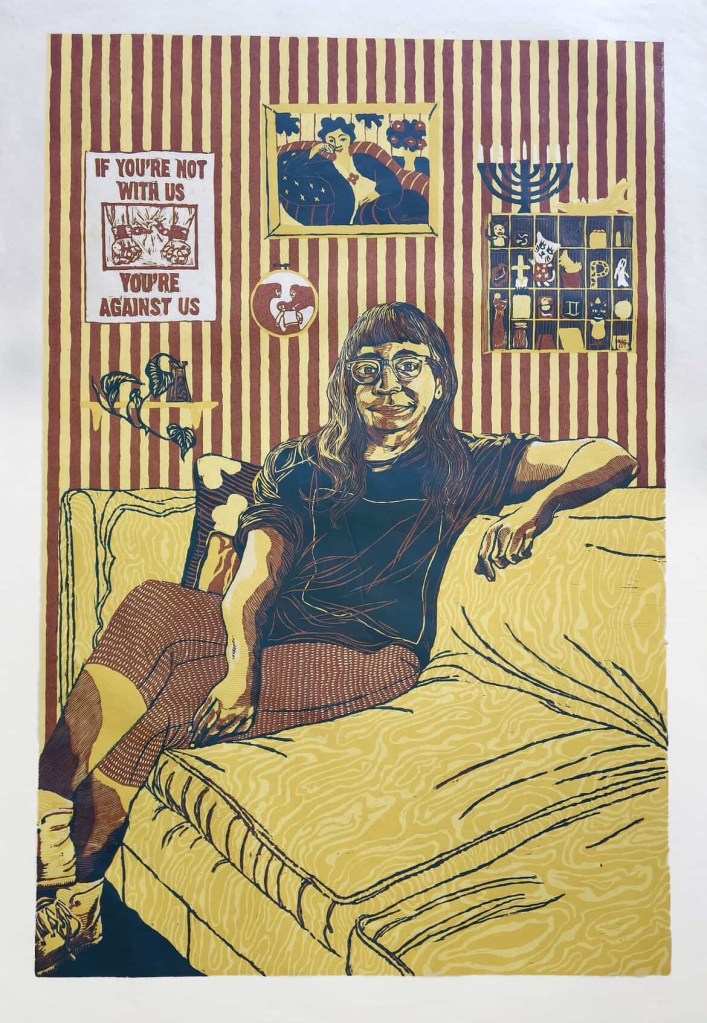
Art by Camille Vizena
Selected quotes:
“Like I knew drug etiquette, drug culture and all these things from being in it, but I didn’t know safety, and I didn’t know anyone who was like unapologetic and into advocating for other people. But one central character was, before Narcan by name existed, this girl who gave me some vials of intramuscular naloxone. … She was asking me about myself and gave those to me, and I didn’t even know what it was. And she told me and I kept them and I still have them. … it’s a sacred remnant of my relationship with this person and a path and trajectory that has led me to become who I am. … We lost her last year … and I always try to remember; my overdose will not be tragic. That’s how she wanted to go out, and I only can grasp onto that she felt fucking great. But I love her with all my heart and she’s who brought me into this. I didn’t even know the words harm reduction. I just was shown this love. All these people in my life at that time, I was either completely hiding my life from, or it was conditional … And [she] like saw me. … the concept of someone not even caring what’s in my body or not in my body, but just checking in with me and being like a sister–that was really powerful”
“I was visiting home in Lake Charles, and I met this girl who was walking around our city, which looked war-torn after Hurricane Laura. And she was like, she had a wagon full of Narcan. And I was like, who the fuck is this? And so, I met her, and she had linked up with a girl that I knew as well. And she was starting a harm reduction organization. And that’s the first time I heard those words, really.”
“Harm reduction is like my like lifeblood. It’s my soul. … it’s also something that I understand as part of an underbelly and an underground as is much of who I am. And to be able to be nimble and pivot and get creative and resourceful because we’ve always had to be. … Harm reduction has also given me myself back, like a reclamation of myself outside of being defined by others and by what’s in my body or what’s not in my body.”
“I am definitely a trinket collector, a [harm reduction] ephemera collector. Just as a proclamation that we were here. That you can’t tell us we weren’t because we have this proof. And as a recognition that everything is so fucking fleeting. And so, to grasp it, like any memory, any statement where it was, you know, our feet were on the ground here, and we had shit to say and we had shit to do, and we did it, and we had each other. I think it’s the biggest thing. … [I hold] onto things, like as a testament, almost like you can’t rip this from my hands, like spiritually or physically. I will go down fighting for them.”
“I think with the commodification of harm reduction lately, [collecting ephemera] has been something sacred as well and such a personal fight because it’s like, no, like our hands made these. And [these materials] have been passed down by generations, like [from] Santa Cruz and ACT UP and things like that. It’s like a generational honor that, hopefully, we can also pass along and build upon.”
“Being in the rural South, in the Gulf Coast, we are so far behind New York City and coastal areas that I’m almost grateful in a weird way because we aren’t receiving as much backlash publicly because we never were public. … in that area we’ve had to build what we have instead of it already being there. … I’m almost grateful that we never had an official ordinance on paper because it can’t be undone. So, we’re just going to stay in the underbelly and do our thing and code switch when needed”
“Since coming into harm reduction and returning to substance use, I’ve never felt more myself. I’ve never felt more like sure of who the fuck I am. I’ve never felt more myself and like empowered in that. … [it] has allowed me more compassion toward myself, around my past, around the people that I’ve lost.”
“This is life or death. This is about dignity. This is about liberation.”
“The South is seen as this lost cause, as this expendable place, as a scapegoat for why our country is the way it is. But there are more beautiful, resilient people in the South that I have met compared to anywhere else. And there’s more resistance there. When the boot is on your neck, you really see what people are made of. And there’s a lot of boots in the South. … We might not have fancy vending machines, and we might not have like supervised consumption, [but] we are out here”
“I hope for the movement of harm reduction that we can find ways to bolster each other and be there for each other and create a sustainability of sorts that goes beyond the back and forth of legality.”
“I love to think, even if it is generations from now, of a world where there is no prohibition and where it is universally recognized that people deserve to live the life that they want to unapologetically and without risking their safety, their freedom.”
FULL INTERVIEW (ENGLISH):
 Labor of Love: A Global Harm Reduction Oral History Project