Leo Jefferys
Ireland and canada
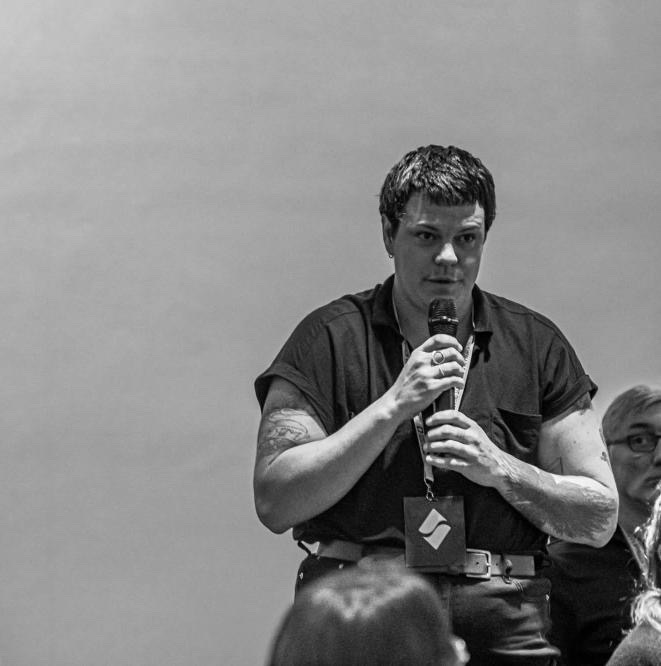
Leo is an independent harm reduction consultant and drug user activist based in Ireland. They have a post grad diploma in Substance Use from Queens University Belfast and currently have a special interest in non-carceral futures and stimulant agonist treatment. They are originally from the unceded territories of the Syilx nation and lived as an uninvited settler on the territories of the Musqueam, Squamish, and Tsleil-Waututh, colonially known as Vancouver, BC, Canada for 15 years before relocating to Ireland.
Selected Quotes:
“I just did a webinar on trans harm reduction, drug user rights, trans rights, how they intersect. … I got involved in DIY is because when I realized that I wanted to kind of take the step and start taking hormones and get surgery and all this, I realized that Ireland wasn’t as supportive as back home [in Vancouver]. … I want to help and promote this as much as possible. [I`ve been] involved in actions and group chats and planning and using my connections with the Irish Health Service as well and trying to connect them to the activists to be like, y’all need to listen to these folks. … [My identity] really ties into the work I do because there’s a lot, there’s still a lot of, shocker, transphobia and exclusion in advocacy spaces and in drug user advocacy spaces.”
“What I’m learning and finding is that it goes back to all things with the drug war, colonialism and class. Canada, as a state built on the genocide of indigenous people, that colonialism is still so pervasive throughout all of its policies. … And then coming to Ireland, also, which has experienced colonialism and class, like inequity, and is still experiencing those things. I see a lot of similarities between the way that the Canadian state treats indigenous people and the way the British state and now the Irish state treat working class Irish people. … Ireland doesn’t have a lot of funding, although now it’s a really wealthy country. There’s a lot of corruption and that wealth does not trickle down. … There’s a lack of public health funding and support. … Harm reduction, it’s a very, very new thing [in Ireland]. We only got the first safe injection site this year, and they only got methadone in 2000.”
“I think harm reduction was designed and was pushed as a response to the systemic violence of drug policy … we saw a lot of the kind of formalization or advocacy in the 80s during the AIDS crisis where we had queer people providing needle syringe programs for their communities in response to the state being like, we don’t care if you die. So, a lot of it comes from a response to capitalism and state violence, which is how I got into it… when I was 17, I moved to a punk house that was very DIY. And we were involved in doing gigs, but also doing activism and Food Not Bombs and also just hanging out and getting fucked up and taking care of each other. … it was done in this way where it was trying to live out this existence that made sense to us, outside of what the state was telling us was normal or what we were supposed to want, you know? It was this idea of creating this other way to live.”
“[Harm reduction] is very political for me. And for someone to say that it’s not political, it just doesn’t make sense. I have worked with some people who are like harm reduction is just a health response. … But it’s more about recognizing that people use drugs have a right to use drugs. Drug users have a right to self-determination to determine their lives and how they live it. And also, people use drugs for pleasure. That’s a big conversation even within harm reduction that is missing is that drug use is pleasurable and can be. And for me, drug use is like an indication of wanting to live, not wanting to die.”
“You’re seeing in Canada, like Alberta talking about enforced treatment, Toronto closing down overdose prevention sites, Saskatchewan going back to one-to-one needle exchange, like just these complete 180s. … it’s like a de-radicalization of harm reduction. You know, we’ve like institutionalized it to the point where it’s taken away from us. … I think, a lot of it has to do in part to the loss of all this knowledge because of the AIDS crisis and because of all these queer elders who aren’t with us. I think that has really impacted where we are now.”
“This is where I think the DULF Compassion Club model can be built on because they had everything fucking right. It’s just the supply. What if that supply was community created? … What if we were growing our own plants and synthesizing our own drugs and supplying it from a community angle as well as distributing it?”
”My experience of working in the drug user advocacy field is that there’s one type of drug user whose rights needed to be advocated for. While obviously it’s people who use the most criminalized drugs that are the most stigmatized. … these ideas of like recreational versus problematic … we can just throw out. … because I have used all of those drugs for all of the different reasons. And my weed use has been problematic. And my crack use has been recreational. … Drugs that are “problematic” can also give pleasure. Like when I smoke crack, I just feel completely fine. Like nothing is wrong. … it’s the most Zen moment. We need to look at pleasure
encompassing all substances”
“We can’t wait for these big state structures to give us permission to live.”
FULL INTERVIEW (ENGLISH):
 Labor of Love: A Global Harm Reduction Oral History Project